
‘Caring for nature means caring for one another’
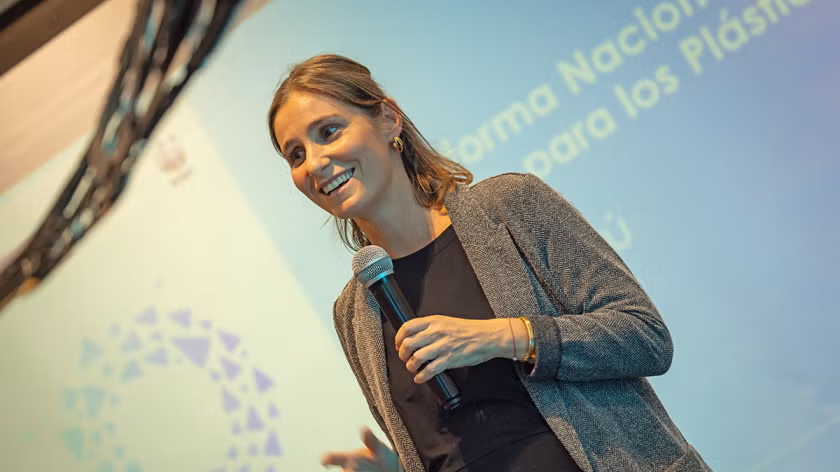
Nadia Balducci is a biologist working with WWF Peru to address plastic pollution from a lifecycle approach and reduce the amount of waste ending up in her country’s rivers and on coastlines. In a GEF Voices interview, she shared life lessons from her efforts to change the trajectory of plastic pollution, including the importance of patience and empathy with all stakeholders involve in pursuit of goals: “The most lasting transformations emerge from trust built over time.”
What do you do? What are you currently focused on?
I am a biologist, and I work to care for nature by addressing one of the most damaging problems we face today: plastic pollution. My professional path has been shaped by a very concrete concern — seeing rivers, beaches, and inspiring natural landscapes covered with waste. In my day-to-day work, I focus on deepening my understanding of the problem and proposing comprehensive, responsible, and actionable solutions for Peru and the region.
I currently lead the national circular economy strategy at WWF Peru, which aims to double plastics circularity and reduce plastic pollution in my country by up to 50 percent by 2030. My work focuses on ensuring that our interventions engage and inspire different actors to take action, from everyday habits to systemic change.
Artisanal coastal communities, local and national authorities, businesses, and civil society are all part of a collective and organized effort that identifies new ways to redesign, reduce, and circulate materials, strengthening a virtuous cycle from product design to final disposal. In doing so, we help protect the environment that sustains our lives and our physical and mental health.
How did you come to work in this field?
While conducting my thesis research in northern Peru, I encountered a dumpsite for the first time. Witnessing how an area as pristine as the desert was turning into a massive landfill pushed me to study the issue in order to understand it and propose local changes. Since 2011, I have continued to learn and contribute to addressing a challenge as vast as plastic pollution and its impacts on climate, biodiversity, the economy, and our health.
Protecting nature means changing, making conscious decisions, and inhabiting our daily lives with respect — for ourselves, for others, and for nature. I began with myself, acknowledging the difficulties, and today I also recognize the challenges and opportunities to work on solutions that emerge from dialogue, shared learning, and collective action.
Is there a GEF-funded project or program that is particularly important to you?
Yes — Plastic Reboot Peru is very close to my heart. We share a common mission: reducing plastic pollution by promoting solutions based on a just and sustainable circular economy. It inspires me because it focuses on prevention and on generating systemic changes that can be sustained over time, complementing local downstream interventions.

The project promotes circularity in the food and beverage sector, one of the largest sources of single-use plastics, through several mutually reinforcing actions: strengthening the regulatory framework — including advancing extended producer responsibility for packaging — fostering stronger collaboration and formal commitments across the plastics value chain, and generating practical knowledge about what enables or prevents change.
A particularly innovative aspect of Plastic Reboot Peru is the implementation of reuse and reduction pilots in markets, supermarkets, food courts, and fast-food restaurants in different regions of the country. These trials test circular solutions and apply social and behavior change approaches, while incorporating gender-sensitive perspectives that recognize differentiated roles in plastic use and disposal.
Finally, what makes this project especially meaningful is that it was co-designed with stakeholders across the plastics value chain, many of whom will also participate in its implementation. This shared ownership reflects something I strongly believe in: the most durable transformations happen when solutions are co-created across sectors.
What life lessons has your work taught you?
My work has taught me that change is not immediate. It is built with patience, by listening and walking alongside people with different interests, priorities, and realities. I have learned that the most lasting transformations emerge from trust built over time and from working together toward a shared and empathetic purpose.
The state of the global environment is concerning. What gives you hope?
What gives me hope is seeing people who do not give up — young people, communities, and leaders who believe that another way of relating to nature is both possible and necessary. I am also encouraged by the fact that, even in the face of major challenges and within geopolitically intense contexts, spaces for cooperation and alignment around shared goals continue to emerge.
One example is the global plastics treaty negotiations, where a strong majority of countries remain firm in their pursuit of a robust agreement—one capable of driving the real and urgent change this global crisis demands. This means a treaty that takes a full lifecycle approach to plastics, addresses unsustainable production and consumption, and establishes global, legally binding measures to phase out the most harmful and unnecessary plastic products while accelerating circular solutions.
What advice would you give to a young person interested in a career like yours?
No matter the career they choose, the talent they have, or the time they can offer, it is always possible to contribute positively to the care of nature and people. Keeping curiosity and empathy alive are powerful guiding lights for navigating complex and, at times, resistant contexts.
Today we face urgent challenges such as biodiversity loss, climate change, and plastic pollution. Addressing them requires people from many disciplines who are willing to question current systems and help build more sustainable and circular solutions.
Caring for nature ultimately means caring for one another. Every action counts, and when many people choose to get involved, a collective force emerges—one that can transform realities and create a more hopeful future.